Email Marketing for Creators Who Hate Email Marketing (A Flodesk Review)
You know that feeling when someone tells you to "just start an email list" like it's as easy as ordering coffee? Yeah. They conveniently leave out the part where you spend three hours staring at a clunky email platform wondering why building a simple welcome sequence feels like filing your taxes.
If you've been avoiding email marketing because every tool you've tried makes you want to throw your laptop into the ocean, you're not lazy. You're just using the wrong platform. And I'm here to talk about the one that finally made me stop procrastinating on my email strategy: Flodesk.
Full transparency: This post contains affiliate links. If you sign up for Flodesk through my link, I earn a small commission at no extra cost to you. I only recommend stuff I actually use or would willingly inflict on my clients!
Let's Get One Thing Straight
Your Instagram could disappear tomorrow. Your TikTok account could get shadowbanned while you sleep. Your Threads reach could tank because Meta decided to tweak an algorithm over lunch. But your email list? That's yours. No algorithm stands between you and the people who actually want to hear from you.
Email marketing isn't sexy. It's not going to get you a viral moment or a screenshot on someone's story. But it IS the thing that consistently generates revenue for creators who are serious about building a business (not just a following). The data backs this up: email marketing generates an average of $36 for every $1 spent, which puts every social platform's ROI to shame.
So why do so many creators avoid it? Because most email platforms were designed by people who apparently hate joy.
What Makes Flodesk Different From Every Other Email Platform
I've tried the big names. Mailchimp (confusing pricing that punishes you for growing). ConvertKit (functional but visually about as exciting as a spreadsheet). Constant Contact (feels like it was designed in 2008 and never got the memo that it's not 2008 anymore).
Flodesk was built specifically for creators and small business owners who want their emails to look gorgeous without needing a design degree or a three-hour YouTube tutorial.
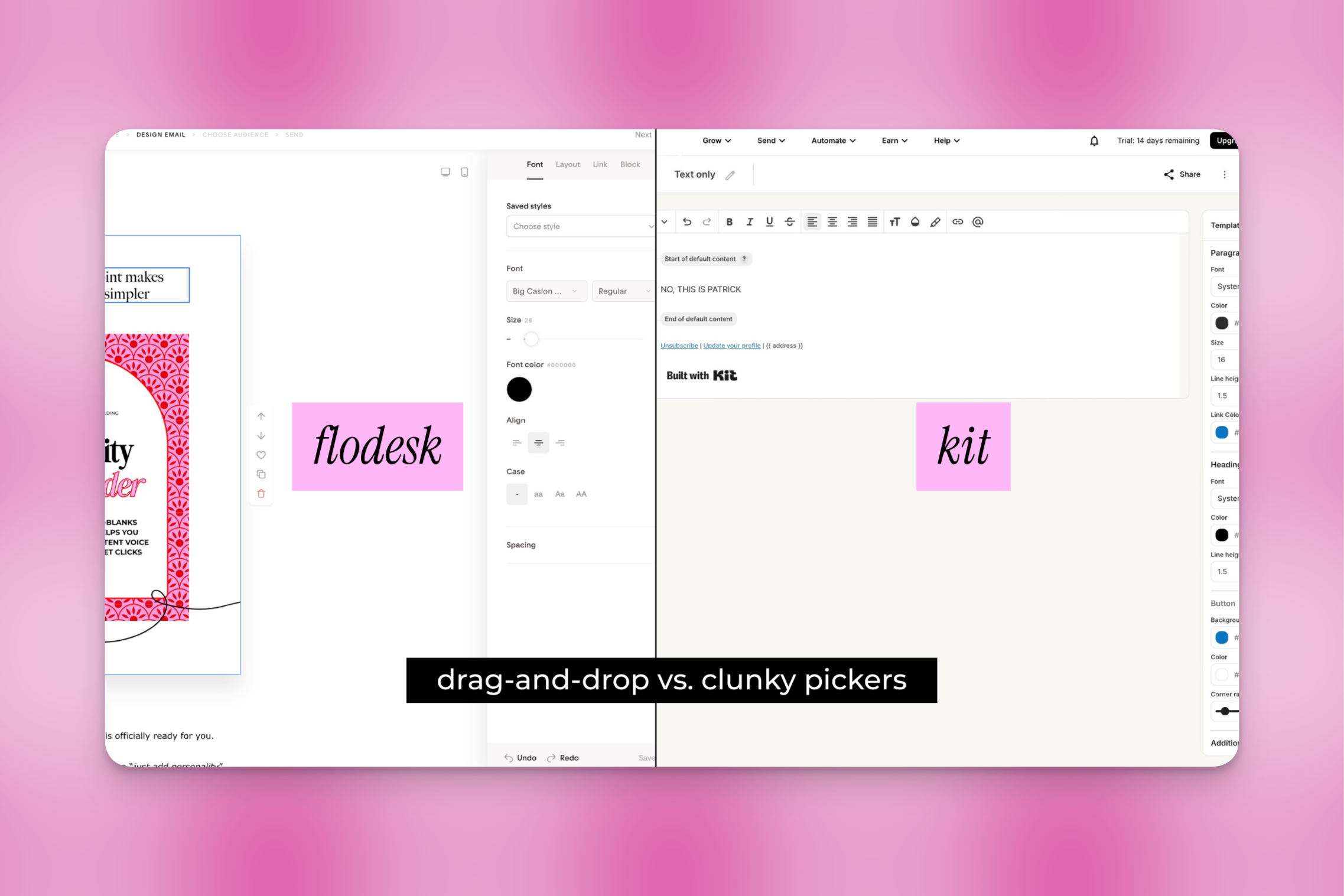
The Flodesk email builder vs. what you've been putting up with. Night and day.
The Design-First Approach
Here's where Flodesk actually stands apart. The templates don't look like they were designed by someone who's never seen a mood board. They're modern, clean, and actually on-trend. You can drag and drop your way to a professional-looking email in minutes, not hours.
And the customization? You can adjust fonts, colors, layouts, and spacing without touching a single line of code. For visual creators who care about how their brand shows up in someone's inbox, this is a genuine game-changer.
If you're curious about making everything from your emails to your socials feel like you, check out our post on building a cohesive brand identity.
Workflows That Don't Require a PhD
Flodesk's workflow builder is visual and intuitive. You can set up welcome sequences, nurture sequences, and sales funnels by literally dragging boxes around and connecting them. If you've ever tried to build an automation in Mailchimp and felt like you needed an engineering degree, you'll appreciate how Flodesk strips away the unnecessary complexity.
The workflows include triggers like "subscriber joins a segment," "subscriber submits a form," or time-based delays. It covers the essentials without overwhelming you with 47 conditional logic branches you'll never use.
Forms and Landing Pages That Don't Look Like 2012
Flodesk's opt-in forms and landing pages are beautiful out of the box. Full-page landing pages, inline forms, pop-ups, and link-in-bio pages are all included. And they actually match the aesthetic quality of the emails themselves, which sounds obvious but is shockingly rare.
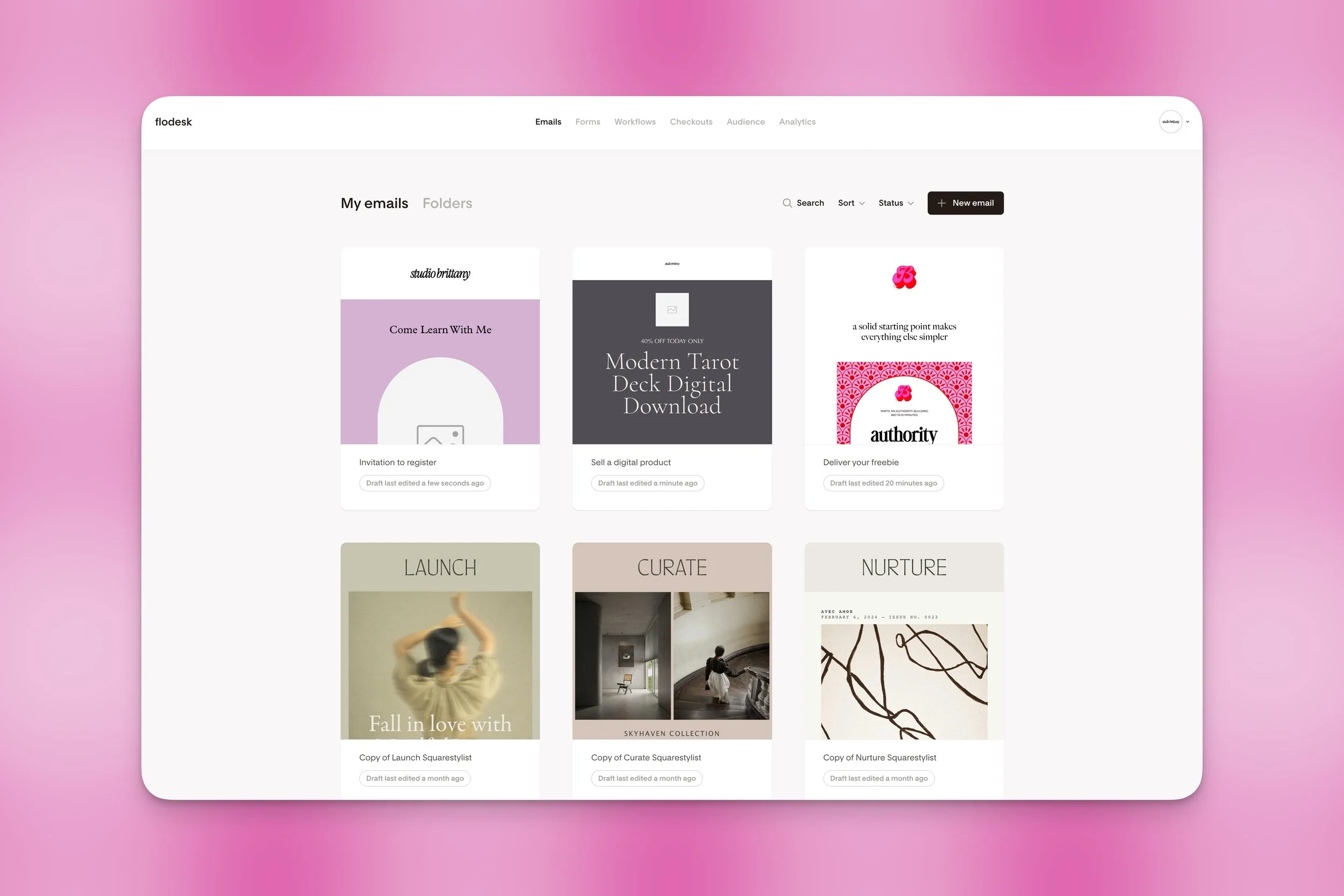
Flodesk opt-in forms and landing pages that actually look like they belong in this decade.
The Features That Actually Matter (And the Ones That Don't)
What You'll Actually Use Daily
Email Builder: Stunning templates with genuine drag-and-drop simplicity. Customize everything without code.
Workflows/Automations: Visual workflow builder for welcome sequences, sales funnels, and nurture campaigns. Set it and (mostly) forget it.
Segmentation: Organize subscribers by interest, behavior, or however your brain categorizes people. Send targeted emails to specific groups instead of blasting everyone with the same message.
Analytics: Open rates, click rates, subscriber growth. The metrics you need without the 47-tab dashboard overwhelm.
Checkout: Flodesk added a native checkout feature so you can sell digital products and services directly through your emails. No third-party integration required. This is huge for creators selling templates, courses, ebooks, or services.
Most email platforms feel like they were designed to punish creative people. Flodesk was designed for us. Start your free trial and finally send emails you're not embarrassed by.
What's Missing (Being Honest)
Advanced segmentation and tagging: If you need complex conditional logic with 15 different subscriber tags triggering different sequences based on behavioral scoring, Flodesk isn't your tool. It handles the basics well but won't satisfy enterprise-level complexity.
A/B Testing: Limited compared to platforms like ConvertKit or ActiveCampaign. You can test subject lines but the testing capabilities aren't as robust as some competitors.
Reporting depth: The analytics are clean and useful but not as granular as what you'd get from a platform designed for data-heavy marketers.
Who Flodesk Is Actually For (Honest Take)
Perfect For You If:
You're a visual creator or brand-conscious business owner. If how your emails look matters to you (and it should), Flodesk delivers.
You're a solopreneur or small team. You don't need enterprise features. You need something that works, looks good, and doesn't eat your entire afternoon every time you want to send a newsletter.
You're just starting your email list. Flodesk's free plan lets you start with up to 2,500 subscribers (for free, no credit card), and every paid plan includes unlimited sends. Start small and scale at your own pace.
You sell digital products or services. The built-in checkout feature means you can sell directly from your emails without stitching together three different platforms.
Maybe Not For You If:
You run a large e-commerce operation with complex segmentation needs. You'll outgrow Flodesk's segmentation capabilities.
You're a data-obsessed marketer who lives in analytics dashboards. The reporting is solid but not deep enough for heavy data analysis.
You need advanced API integrations. Flodesk integrates with major platforms but the API capabilities aren't as extensive as some competitors.
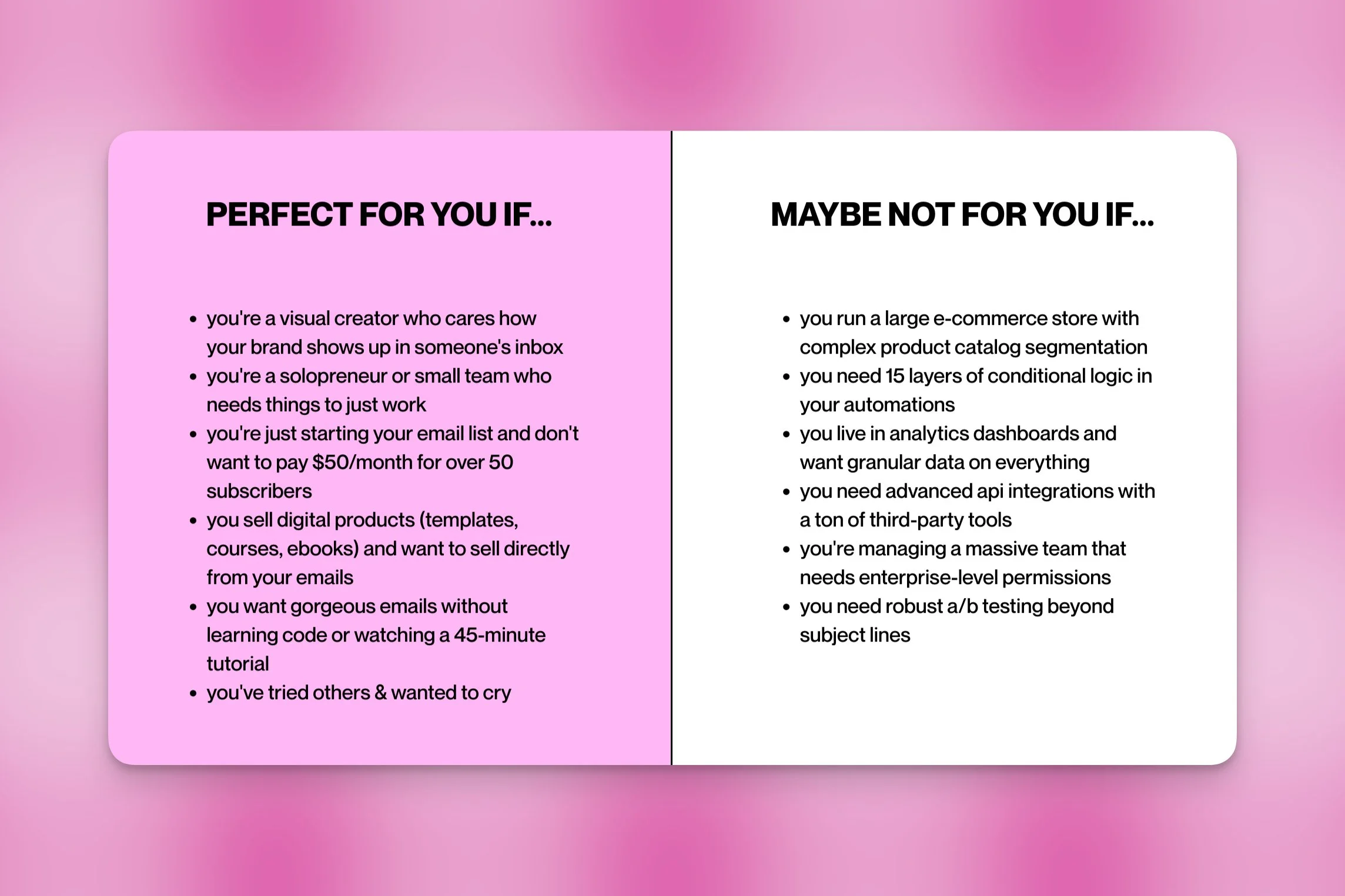
The honest breakdown: is Flodesk actually right for your business?
Flodesk Pricing: Still More Affordable Than You'd Expect
Here's where things get interesting. Flodesk used to be famous for flat-rate unlimited pricing (and yes, that was glorious). As of late 2025, they've moved to a tiered model like most email platforms. But here's the thing: the pricing is still competitive, and every paid plan includes unlimited email sends.
Here's what you're looking at:
Free Plan: Up to 2,500 subscribers and 15,000 emails. Includes automation, segmentation, templates, landing pages, and popups. Seriously, that free tier is generous.
Lite ($19/month): Up to 25K subscribers with unlimited sends. You get all the beautiful templates and custom fonts. The catch? Only one automation workflow and Flodesk branding stays on your emails.
Pro ($25/month): This is the sweet spot. Unlimited workflows, removable branding, brand color consistency, and advanced analytics. For six bucks more than Lite, it's a no-brainer.
Everything ($49/month): Built for creators who sell. Unlimited checkouts, payment plans, abandoned cart recovery, and sales pages all included.
You can compare the full breakdown on Flodesk's pricing page. And for context on how that stacks up, Email Tool Tester has a solid pricing analysis.
The big takeaway: even with the new pricing model, Flodesk still gives you unlimited sends on every paid plan. And that free tier is perfect for creators who want to test the waters before committing.
Stop wrestling with email platforms that make you dread opening your laptop. Flodesk keeps things gorgeous and simple so you can actually focus on what you're saying (not fighting with your tools). Try it free and see what email marketing looks like when it doesn't make you miserable.
How to Get Started Without Overthinking It
Step 1: Set Up Your Account
Sign up, pick a template you love, and customize it with your brand colors and fonts. This should take about 15 minutes, not three days.
Step 2: Create Your First Opt-In Form
Build a simple form offering something valuable in exchange for an email address. A free guide, a checklist, a template. Something your audience actually wants (not just "subscribe to my newsletter" because nobody wakes up excited about generic newsletters).
Step 3: Build a 3-Email Welcome Sequence
Email 1: Deliver the thing you promised and introduce yourself.
Email 2: Share your most valuable piece of content or biggest lesson.
Email 3: Soft pitch your paid offer or invite them deeper into your world.
That's it. Three emails. You can get fancier later, but starting simple beats starting never.
Step 4: Send Your First Newsletter
Pick a consistent schedule (weekly works great for most creators) and actually stick to it. Your emails don't need to be literary masterpieces. They need to be valuable, authentic, and consistent.
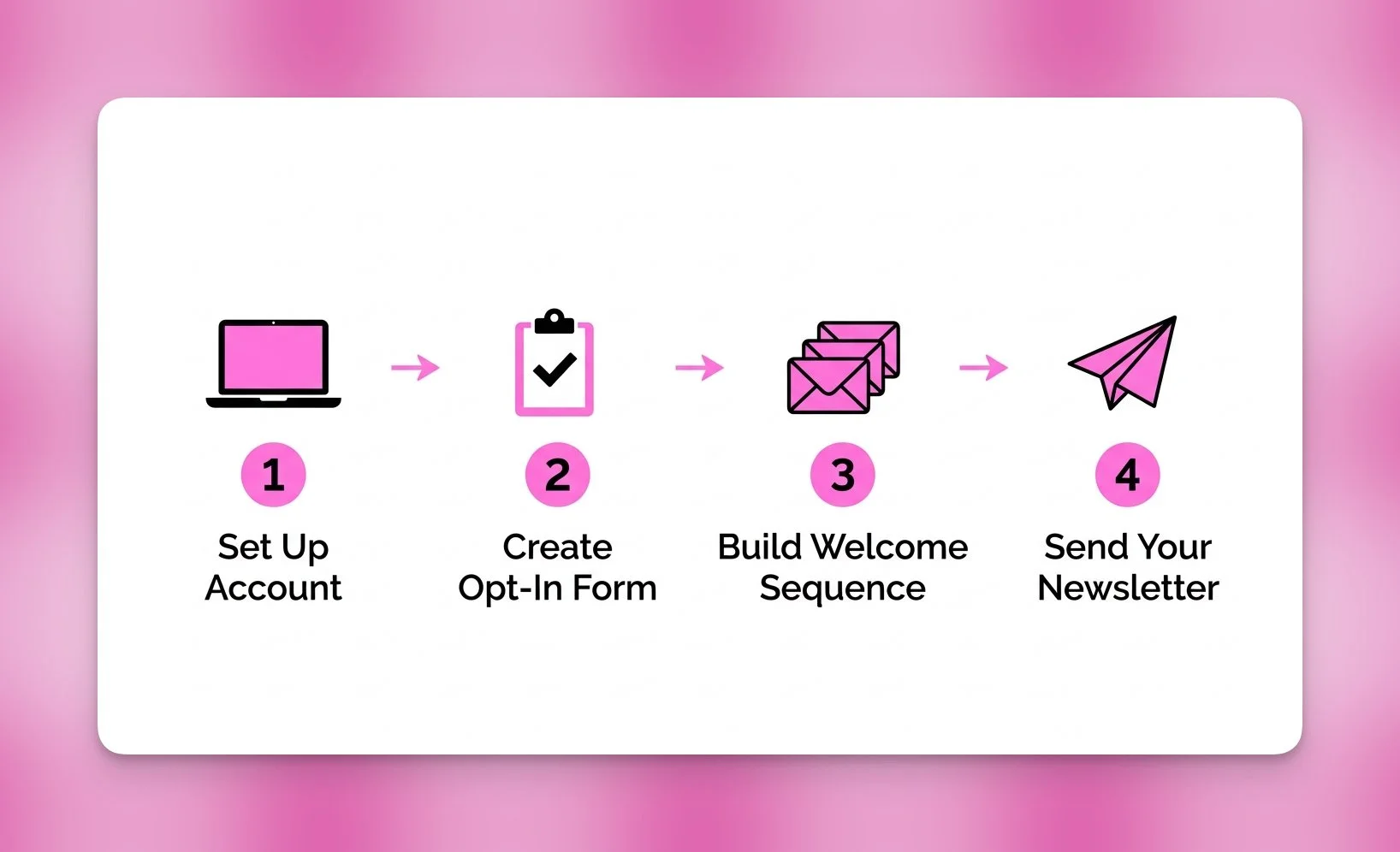
Four steps. That's it. Email marketing doesn't have to be a whole personality.
The Honest Pros and Cons
What Works
Design quality is unmatched in this price range. Your emails will look like you hired a designer.
Generous free tier and unlimited sends on all paid plans. Build your list without dreading your next invoice.
The learning curve is gentle. If you can use Canva, you can use Flodesk. Seriously.
Built-in checkout eliminates the need for separate e-commerce tools for digital products.
Customer support is responsive and helpful. When you do get stuck, you're not screaming into a void.
What's Annoying
Segmentation has limits. Power users will hit the ceiling on complex tagging and conditional logic.
Pricing changed. Flodesk used to have a legendary flat-rate unlimited plan, but they moved to tiered pricing in late 2025. The free plan is generous, but the unlimited-everything days are gone for new users.
A/B testing could be more robust. Subject line testing exists but it's basic.
Deliverability requires attention. Like any platform, you need to maintain good sending practices. Flodesk gives you the tools but it's not magic.
Ready to try email marketing that doesn't make you miserable?
It’s Not a Chore for Creatives
Email marketing doesn't have to feel like a chore designed to punish creative people. The right tool makes all the difference between "I should really send that newsletter" and actually sending it consistently while watching your revenue grow.
Flodesk isn't perfect (nothing is, and anyone who tells you otherwise is selling something). But for creators who care about design, want simplicity without sacrificing strategy, and refuse to get punished for growing their audience, it's the closest thing to an email marketing platform that actually gets it.
Your email list is the one piece of your online presence that no algorithm can touch. Time to start treating it that way.
Get started with your free Flodesk trial today, I promise you won’t regret it.
FAQ
-
Absolutely. Flodesk's free plan gives you up to 2,500 subscribers and 15,000 emails per month, which is one of the most generous free tiers out there.
The intuitive interface means you won't waste hours learning the tool instead of building your business, and when you're ready to upgrade, paid plans start at just $19/month with unlimited sends.
-
Flodesk wins on design quality, pricing transparency, and ease of use. Mailchimp wins on advanced features, integrations, and analytics depth. If you're a visual creator who wants beautiful emails without complexity, Flodesk is the better fit.
If you need enterprise-level segmentation and detailed reporting, Mailchimp offers more (at a significantly higher price as your list grows).
But honestly? Mailchimp is at the bottom of the list of other email marketing platforms I would recommend. More on this later.
-
Yes. Flodesk Checkout lets you sell digital products, services, and subscriptions directly through your emails and landing pages. No need for a separate e-commerce platform.
You can create product pages, accept payments, and deliver digital files all within Flodesk. It's particularly useful for creators selling templates, ebooks, courses, or consulting services.
-
Flodesk's deliverability is solid when you follow best practices: authenticate your domain, maintain a clean list, send consistently, and write emails people actually want to open.
No email platform guarantees 100% deliverability. Flodesk provides the authentication tools and monitoring you need, but deliverability is always a shared responsibility between the platform and the sender.
If you want to deep-dive on this, Mailmunch has a comprehensive deliverability guide worth bookmarking!
-
For solopreneurs and small businesses selling digital products, yes. The built-in checkout and beautiful email templates make it great for product launches and sales sequences.
For larger e-commerce operations with complex product catalogs, extensive segmentation needs, and advanced automation requirements, you'll likely need a platform like Klaviyo or ActiveCampaign that's purpose-built for e-commerce scale.
-
Yes. Flodesk supports CSV imports for your subscriber list, so you can bring your contacts from any platform.
Your email designs won't transfer (you'll rebuild using Flodesk's templates, which is honestly an upgrade), but your subscriber data and segments can be imported. The process typically takes less than an hour for most creators.
-
Flodesk integrates with Shopify, Zapier, Instagram, WordPress, and several other platforms. The Zapier integration opens up connections to thousands of apps.
It's not as integration-heavy as Klaviyo, Mailchimp or ConvertKit, but it covers the essentials most creators need. If you rely heavily on specific integrations, check Flodesk's integration page before switching.