The Internet Has an Originality Problem
AI didn’t kill branding, it raised the bar.
I spent over an hour reading landing pages that all sounded suspiciously identical. Apparently everyone is helping people "scale," and somehow nobody can define what that actually means.
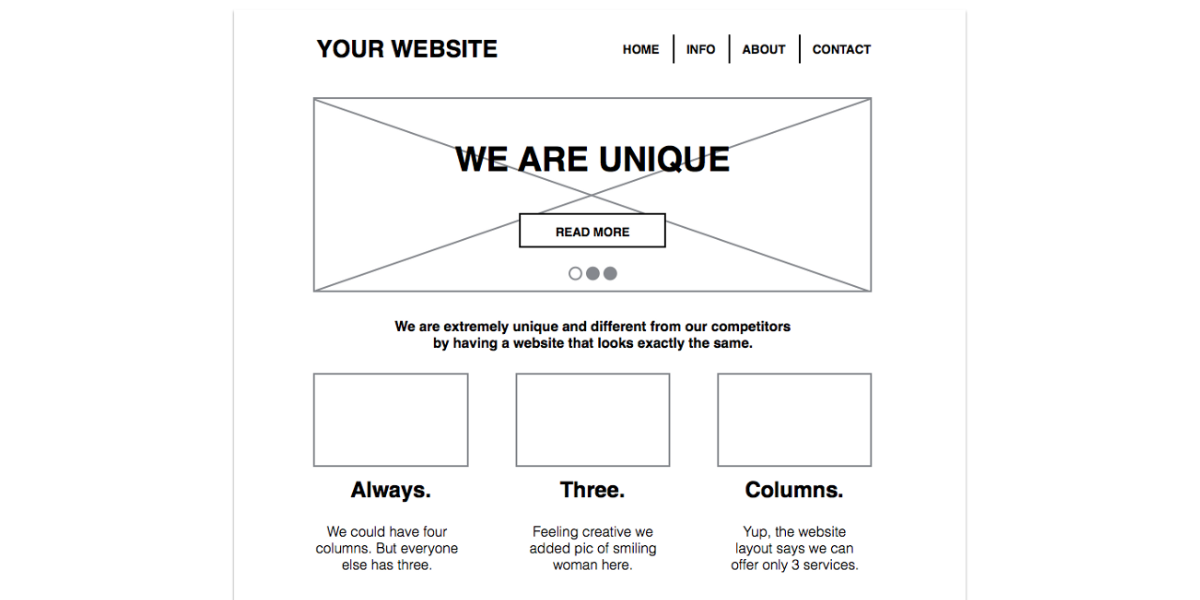
Every headline promises a proven framework. Every bio sounds like someone fed LinkedIn into ChatGPT and hit regenerate until it felt expensive. By the tenth page, they'd all blurred together: different colors, different fonts, different founders, the exact same ideas.

That's when it clicked. The internet doesn't have an AI problem. It has an originality problem, and AI just made it impossible to ignore.
For a while I thought I was being dramatic about it. Then I started keeping a running list of pages that used the phrase "proven framework" in the first three lines.
I stopped counting after twelve. Twelve. In one afternoon. Not because those businesses are lying about having a framework, but because everyone reached for the exact same three words to describe it, and none of them noticed.
The Barrier Has Changed
There was a time when building a polished brand actually meant something. A clean website, a compelling sales page, a thoughtful email sequence, professional photography, clear messaging. Those things weren't easy to create. They required time, money, skill, or all three, and whether we realized it or not, they became signals of credibility.
If you could afford a good designer and a good copywriter, people assumed you could probably also deliver a good product. That assumption wasn't always fair, but it was consistent.
Today, anyone can generate something that looks polished in under an hour. That's not a criticism. It's actually incredible. Small business owners who couldn't afford copywriters now have access to writing tools. Designers can move faster. Solopreneurs can launch ideas without waiting six months or spending five figures.
That's a good thing, full stop, and I'm not going to pretend otherwise just to make a tidier argument.
But there's a consequence we don't talk about enough: AI lowered the barrier to producing polished marketing, and it also lowered the barrier to sounding like everyone else. Both things are true at the same time.
The tools didn't do anything wrong. They did exactly what they were built to do, which is compress the distance between an idea and a finished-looking asset.
Nobody warned us what happens when every single person compresses that same distance using the same handful of tools trained on the same handful of patterns.
When Signals Become Cheap
Marketing has always been about signals. A beautiful website signals professionalism. A confident sales page signals expertise. A polished brand signals trust.
The problem is that signals only work while they're difficult to fake. The second a signal becomes cheap to produce, it stops signaling anything except that you have access to the tool that produces it.
Think about verification badges on social media. Years ago, seeing one meant something. It meant a platform had done some amount of vetting, that the account probably belonged to who it claimed to belong to, that there was a small barrier between "anyone" and "verified."
Now, not so much. The badge didn't disappear. Its meaning changed, because the cost of getting one changed.
I think polished marketing is going through the same transition, just slower and with less public conversation about it.
Having a beautiful website no longer tells me you're good at what you do. It tells me you know how to use modern tools, and those are two very different things. One is about competence in your actual craft. The other is about competence in software.
Execution has become accessible, which means execution is no longer the competitive advantage it used to be. It's table stakes now, and table stakes have never been what made anyone remember you.
The Rise of Synthetic Expertise
We're living through a strange moment online. The internet has more experts than ever, and somehow, less original thinking.
Every creator has a framework. Every coach has a signature method. Every landing page promises the secret nobody else is talking about, despite the fact that roughly four hundred other landing pages are promising the exact same secret in the exact same font.
Sometimes those claims are genuine. Sometimes they're recycled from someone else's genuine claim three years ago. Sometimes they're fully generated by a tool that has never run a business a day in its life.
The result reads the same either way, which is precisely the problem. When the surface looks identical regardless of what's underneath it, the surface stops being useful information.
The more polished everything becomes, the harder it is to tell what's actually earned. Authority used to be demonstrated, slowly, through work you could point to.
Now it's often designed, quickly, through a template and the right adjectives.
That's not because people are dishonest. Most of them aren't. It's because the tools got really good at producing the appearance of expertise, and appearance is a lot faster to build than the real thing.
What AI Can't Manufacture
Here's what I don't think AI can give you: a story you only learned by screwing something up, changing your mind after new evidence, an opinion that costs you followers, the judgment that comes from making the wrong decision three times before finally making the right one.
You can't prompt your way into a scar. You can only get one the regular way.
Taste. Not aesthetic taste, though that matters too. Judgment. Knowing what to leave out, knowing which trend isn't worth chasing even when everyone else is chasing it, knowing when conventional advice falls apart because real people don't behave like marketing textbooks say they will.
Those things don't come from prompts. They come from experience, from the specific and unglamorous accumulation of having tried something, watched it fail or succeed, and paid attention to why.
AI can absolutely help you communicate them once you have them. It can help you say the thing more clearly, faster, with better structure.
It just can't invent them for you, and I don't think it ever will, because taste isn't a data problem. It's a lived one.
Originality Isn't About Being Different
I don't think originality means having ideas nobody has ever had before. That bar is basically impossible and also kind of beside the point. Most of us are building on ideas that already exist, remixing frameworks other people built, standing on strategies that have been around for decades in one form or another.
Originality comes from perspective. It's taking a familiar idea and filtering it through your own experiences, mistakes, biases, and observations until it comes out sounding like nobody but you.
Two people can explain the exact same strategy, word for word in outline form, and one version will be forgettable while the other makes you rethink the way you work.
The difference isn't information. It's interpretation, and interpretation is the one thing that can't be copy-pasted from a competitor's site no matter how good the prompt is.
That's the part people remember. Not the framework itself, but the specific, slightly strange, unmistakably human way someone chose to explain it.

So What Does This Mean for Brands
Ironically, I think AI is going to make branding more important, not less. Not because everyone needs a prettier logo, though sure, get a prettier logo if you want one. Because everyone needs a clearer point of view, and that's a much harder thing to fake convincingly at scale.
The brands I'm paying attention to lately aren't the ones with perfect copy. Perfect copy is everywhere now, which means it's basically wallpaper. They're the ones that sound unmistakably like a real person sat down and wrote it, typos and tangents and all. They have opinions, and they're willing to state them even when the opinion isn't universally popular.
They admit uncertainty instead of manufacturing false confidence. They evolve publicly, which means they let you watch them change their minds. They tell stories that couldn't have happened to anyone else, because those stories are actually theirs.
They aren't trying to sound smarter. They're trying to sound real, and that's getting harder to fake the more AI-generated polish floods every feed.
I think that's a good thing. It raises the price of honesty back up to where it should have been the whole time.
The Future Isn't Less Human
People keep asking whether AI is replacing creativity. I think that's the wrong question, and I think it keeps getting asked because it's a more comfortable question than the real one.
The better question is this: what becomes valuable when execution is no longer scarce?
My answer: taste, judgment, curiosity, experience, a point of view. All the things that were always the actual differentiator, even back when a polished website made it look like execution was the differentiator.
Execution was never the moat. It just looked like one because it used to be expensive.
AI didn't kill branding. It made generic branding easier than ever, which means the brands willing to say something specific, tell the truth even when it's messy, and sound like an actual human being have never had a bigger opportunity.
The competition just got a lot less competitive, in a weird way, because most of it is busy sounding like everyone else.
Because when everyone can create polished marketing, polish stops being the thing that makes people pay attention. Originality does. It always was going to.
AI just moved that up the timeline.